
Instrument-Assisted Soft Tissue Mobillisation in Dewsbury
Some areas of scar tissue and fascial restriction sit too deep or too localised for hands alone to fully reach. Instrument assisted soft tissue mobilisation, known as IASTM, solves this using specially shaped stainless steel tools that allow a therapist to detect and treat exactly where the problem lies with a precision that fingers alone cannot always achieve.
At Naseem Sports Therapist in Dewsbury, IASTM has become a core part of how we treat stubborn muscle tightness, old scar tissue, and the kind of restricted movement that other treatments have not fully resolved.
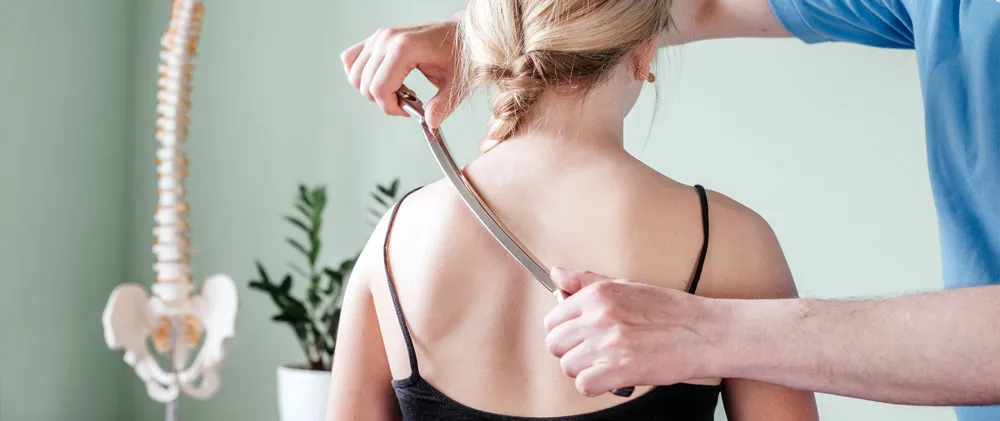
How the tools actually work
The instruments used in IASTM are smooth edged and specifically shaped to follow the contours of different muscle groups. As your therapist runs the tool along the skin, they can feel subtle changes in texture that are difficult to detect with hands alone, areas where the tissue feels gritty, fibrous, or stuck rather than smooth and pliable.
Once a restricted area is found, controlled strokes are applied with the tool to break up adhesions and scar tissue, encourage blood flow into the area, and signal the body to begin remodelling that tissue into something healthier and more flexible. It is a process that essentially restarts the healing response in tissue that has become stuck in a pattern of tightness or scarring.
Mild redness often appears after treatment in the area worked on. This is a normal sign of increased blood flow rather than bruising, and it typically fades within a day or so.
What this treatment is most effective for
IASTM at our clinic is commonly used to treat:
- Lower back pain linked to fascial restriction along the spine and surrounding muscles
- Knee pain and ligament strain where scar tissue or adhesions are limiting movement
- Tennis elbow and golfer’s elbow, both of which respond particularly well to this targeted technique
- Plantar fasciitis, where the tool can reach the dense tissue on the sole of the foot more effectively than manual pressure
- Hamstring and calf tightness that has not fully released through massage alone
- Postural imbalances, where chronic tightness on one side of the body has built up over time
Who tends to benefit most
This treatment suits a wide range of people, but it is particularly effective for:
- Athletes recovering from old injuries that left behind scar tissue
- Gym members with persistent tightness in specific muscle groups despite regular stretching
- Office workers dealing with postural tension that has become chronic
- Anyone with a previous diagnosis involving adhesions, fascial restriction, or soft tissue scarring
- Clients who have tried massage alone without the lasting results they were hoping for
If a particular area of tightness keeps returning no matter how much you stretch or how often you get a massage, IASTM is often able to reach what those approaches could not.
What to expect during your session
Your therapist will start by assessing your movement and asking about the history of the area you want treated, including any previous injuries or surgeries. This helps them understand whether the restriction is recent or longstanding, which affects how the treatment is approached.
The tools are then used along the targeted muscle or fascial line, with pressure adjusted based on your feedback and how the tissue responds. Sessions are usually combined with some form of soft tissue work, since IASTM tends to work best as part of a broader treatment rather than completely on its own.
Most clients tolerate the treatment well. There can be some mild tenderness in the days following a session, similar to how a deep massage might feel, and this usually settles within 24 to 48 hours.
Combining IASTM with other treatments
IASTM is rarely used in isolation. At Naseem Sports Therapist, it is often paired with deep tissue massage, where the combination addresses both the deeper fascial restriction and the surrounding muscle tension together.
For clients managing chronic lower back issues, IASTM frequently complements our back pain treatment programme, helping break down the fascial component of the problem that manual therapy alone sometimes cannot fully address. It is also commonly combined with myofascial cupping therapy for clients with widespread tightness, since the two techniques approach the tissue from different angles.
Book IASTM Therapy in Dewsbury & Batley
Naseem Sports Therapist, 24 Garden St, Ravensthorpe, Dewsbury WF13 3AR
+44 7856 964492
Open 7 days a week, 10:00 AM to 10:00 PM
Serving clients from Dewsbury, Batley, Heckmondwike, Mirfield, and the wider West Yorkshire area.
If a particular area of tightness or old scar tissue has been holding you back, IASTM at our Dewsbury clinic offers a targeted way to finally address it. Book your session today and start working with tissue that actually moves the way it should.